
Therapy Dogs Help Victims Find Their Voice in Courts
PORTLAND, OR – A child was asked to do something most adults would struggle to do: sit in a courtroom, within view of the person accused of harming them, and speak out loud about what had happened.
It is a moment the legal system depends on, but one that can feel almost impossible to endure. Testifying requires more than memory. It requires staying present while revisiting trauma, often in a room filled with strangers, under questioning, with the accused just feet away. For many victims and witnesses, the body reacts before the words can come. Voices falter. Thoughts scatter. Some go quiet entirely, overwhelmed by the weight of the moment.
That is where, in some Oregon courtrooms, an unexpected presence has helped change what that experience feels like.
Across Washington, Multnomah, and Clackamas Counties, courts have increasingly adopted trauma-informed practices to better support victims and witnesses during testimony. Since 2016, the DoveLewis Portland Area Canine Therapy Teams (PACTT) Program has partnered with these courts, beginning in Washington County and expanding to Multnomah and Clackamas Counties by 2019, to provide certified therapy dog teams during testimony.
In one recent case, a child victim took the stand in a sexual abuse trial involving multiple felony charges. The courtroom was still, the kind of stillness that makes every movement and every pause more noticeable. As questioning began, it quickly became clear how difficult it would be to continue. The child struggled to get through answers, the effort visible as the questions turned more specific and more personal.
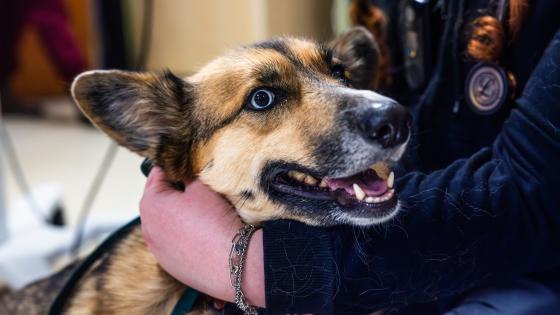
Beside the child was LisaLu, a certified therapy dog, with handler Kathy Wentworth nearby. At first, the child reached down almost instinctively, placing a hand on the dog’s fur. The contact was brief, but it was grounding. As the testimony continued and the questions became harder, the child returned to that same point of contact again and again, each time using it to steady themselves enough to keep speaking.
Eventually, the strain became too much, and the judge called a recess. When the courtroom reconvened, LisaLu remained beside the child. This time, before any questions were asked, the child reached down first, holding on a little longer. The shift was subtle, but it mattered. With that steady presence beside them, the child was able to remain present in the moment and continue, moving through the testimony step by step until it was complete.
That testimony ultimately contributed to convictions on all charges.
Experiences like this are part of a broader shift taking place within parts of the legal system as judges, victim advocates, and attorneys saw firsthand how a calm, nonjudgmental presence could help people navigate moments that might otherwise feel unmanageable.
The role of the therapy dogs is quiet and unobtrusive. They do not interrupt proceedings or draw attention to themselves. Instead, they offer a steady, reassuring presence that gives without expecting anything in return. In a space built for procedure, they provide something deeply human. Something to hold onto when everything feels like too much.
That support also extends beyond the witness stand. The DoveLewis canine therapy teams also visit attorneys, judges, victim advocates, juries, and court staff who are routinely exposed to trauma and the weight of difficult cases. For those carrying the effects of repeated exposure, the canine therapy teams offer brief moments of grounding in an environment that rarely pauses.
“These dogs do not judge, they do not question, and they do not ask anything in return,” said DoveLewis PACTT Director Kathy Loter. “They simply stay, and that kind of presence can help someone feel safe enough to keep going when the moment feels overwhelming.”
When a therapy dog cannot be physically present on the witness stand, the PACTT handlers will provide a small stuffed version instead. Many place it in front of them or hold it as they testify, using it as a focal point when the intensity of the room becomes difficult to face.
Across the three Oregon counties now served by the DoveLewis PACTT Program, therapy dogs have become a steady, if often unseen, part of how some courtrooms are responding to trauma. Their presence reflects a growing recognition that telling the truth in a courtroom is not only a legal act, but also a deeply human one.
For the child in that courtroom, it was not a dramatic intervention that made the difference. It was something much quieter. A hand reaching down. A moment of contact. Something steady enough to hold onto when everything else felt like it might fall away.
And in the end, it was enough to help them keep speaking.
###