

Sky’s Fight to Breathe: Recognizing Choking in Pets
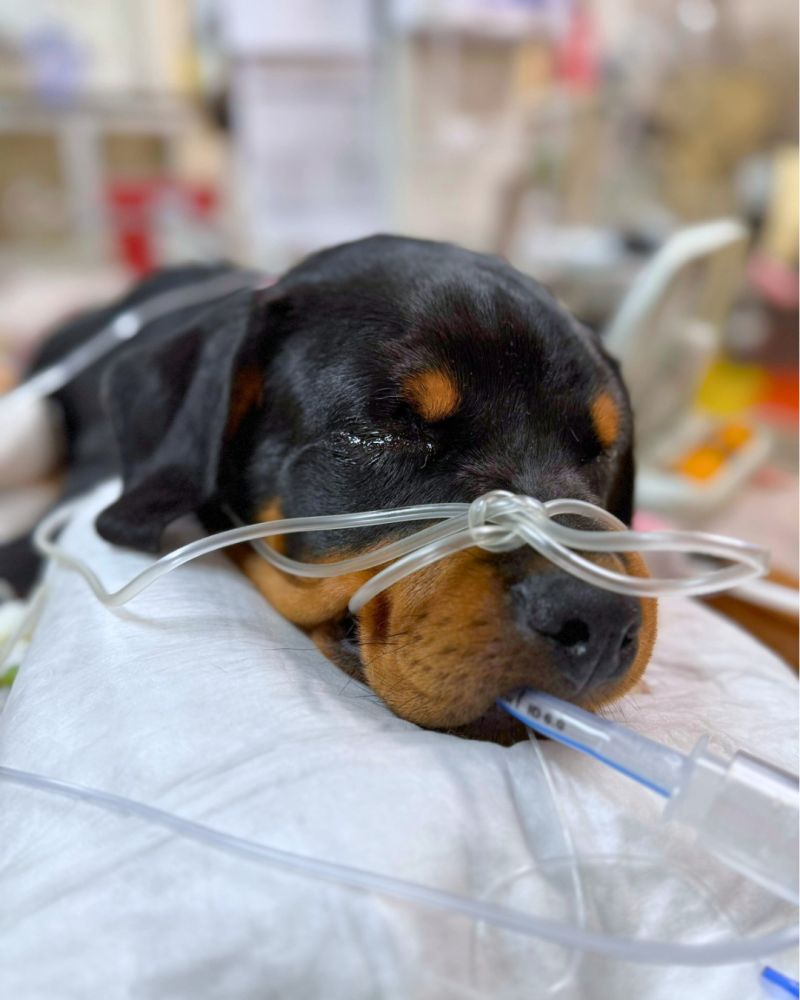 At just 4 months old, Sky nearly lost his life after a piece of shoe leather became lodged deep in his airway. His gums began turning blue from lack of oxygen, and his family rushed him to DoveLewis. Our ER team removed the obstruction, but Sky’s lungs had filled with fluid, leaving him unable to breathe on his own. He spent nearly 24 hours on a ventilator before he was strong enough to take over again.
Sky’s recovery is an important reminder that choking can become life-threatening within minutes and that the danger may continue even after the obstruction is removed.
How to Recognize Choking in Dogs and Cats
Choking occurs when an object partially or completely blocks a pet’s airway. A pet with a partial obstruction may still be able to cough or make noise. With a complete obstruction, little or no air can pass through, and the situation can become fatal within minutes.
Signs that a dog or cat may be choking include:
- Sudden gagging, retching or repeated attempts to swallow
- Pawing at the face or mouth
- Excessive drooling
- Frantic or distressed behavior
- Stretching the head and neck to breathe
- Loud, high-pitched or unusual breathing sounds
- Weak or silent attempts to cough
- Difficulty breathing or gasping for air
- Pale, blue or gray gums or tongue
- Weakness, collapse, or loss of consciousness
Some of these signs can also be caused by respiratory illness, heart disease, nausea or throat irritation. Whatever the cause, difficulty breathing is always an emergency and requires immediate veterinary care.
What to Do if Your Pet Is Choking
- Get veterinary help immediately. If your pet can still breathe or cough, keep them as calm as possible and go directly to the nearest veterinary hospital. Call on the way, if possible, so the team can prepare for your arrival.
- Protect yourself, too. A frightened pet may bite, even if they have never done so before. Do not reach into the mouth of a conscious dog or cat if it could put you at risk.
- Do not blindly search for the object. Trying to grab something you cannot clearly see may push it farther into the airway.
- Use first-aid techniques only if you know how. If your pet cannot breathe or cough effectively, the airway may be completely blocked. Techniques for dislodging an object vary based on the animal’s size and condition, and using them incorrectly may cause injury. Join our pet first-aid interest list to learn about future training opportunities.
- Know when CPR may be needed. CPR is intended for an unresponsive pet who is not breathing and has no heartbeat. If you are trained in pet CPR, begin it while someone else contacts and transports you to the nearest emergency animal hospital. Do not delay veterinary care to attempt techniques you have not been trained to perform.
- Seek care even if the object comes out. Choking can injure the throat or airway, and complications such as fluid in the lungs may not be immediately visible. As Sky’s case shows, the emergency may continue even after the obstruction is removed.
Reducing Your Pet’s Choking Risk
Dogs and cats explore with their mouths, and young animals can be especially curious. A few precautions can help reduce the risk:
- Choose toys and chews that are too large to swallow whole.
- Supervise pets with chews, treats, and toys that can break into smaller pieces.
- Replace damaged toys before pieces begin to separate.
- Keep shoes, children’s toys, string, rubber bands, and other small objects out of reach.
- Use caution with hard chews that may splinter or break.
- Slow down pets that gulp food by using an appropriately designed slow feeder.
- Make sure everyone in the household knows which items are unsafe for pets.
Choking can happen quickly, even with an object that seems harmless. Recognizing the warning signs and knowing where to go could save your pet’s life.
DoveLewis is open for walk-in emergency care 24 hours a day, every day of the year. If your pet is struggling to breathe, come directly to our hospital at 1945 NW Pettygrove St. in Portland. When possible, call us on the way at 503-228-7281 so our team can prepare for your arrival.
Recent Posts

Protecting Your Pets: A Guide to Rat Poison Ingestion and Pet Safety
Discovering that your pet has ingested rat poison can be a distressing situation for any pet owner. Rat poison, although designed to target rodents, poses a serious threat to our beloved pets.

Rainy Season Pet Safety: Hazards, Tips, and Symptoms
It’s that time of year when rain is the rule rather than the exception. With downpours frequently drenching our streets and backyards, the chances of encountering dirty puddles increases. And so do the hazards pets can face.
