
Dog Survives Life-threatening Rattlesnake Bite to the Face
PORTLAND, OR – An 8-year-old dog named Georgie is recovering at home after a rattlesnake bite led to a life-threatening medical emergency and several days of intensive care at DoveLewis 24/7 Animal Hospital.
It began as a walk on a trail when Georgie, a Saint Bernard mix from the Portland area, was bitten on the right side of her face by a rattlesnake.
Within minutes, her face began to swell dramatically. She became weak and unsteady, then developed labored breathing. Her family rushed her to DoveLewis, where veterinarians quickly recognized a life-threatening rattlesnake envenomation, a condition that can cause rapid tissue damage, severe pain, and dangerous changes in blood clotting and circulation.
At DoveLewis, Georgie was immediately taken into critical care. She received pain relief, IV fluids to support circulation, and antivenom to help neutralize the venom in her system. Because snakebite swelling and tissue damage can continue to worsen over hours, she required close, round-the-clock monitoring in the ICU.
Her care team tracked her breathing, bloodwork, and swelling closely, adjusting medications as her condition changed. She needed multiple pain control medications delivered continuously through IV pumps, along with antibiotics and supportive medications to help prevent infection and manage nausea. When her swelling and pain continued to worsen, she received additional antivenom to help reduce further effects of the venom.
For the next several days, the DoveLewis team watched carefully for complications that can follow snakebites, including clotting issues and tissue damage around the bite site. Georgie’s face became severely swollen and bruised, and at times she required strong sedation to keep her comfortable.
Then, gradually, things began to change.
Swelling started to improve. Her breathing stabilized. She became more alert, began interacting with staff, and eventually ate on her own for the first time since the bite, marking a clear turning point in her recovery.
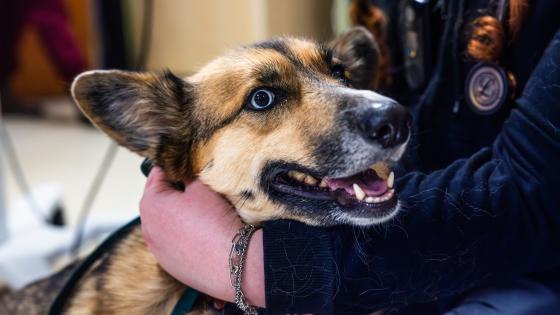
By the time she went home, Georgie was walking on her own, wagging her tail for attention, and continuing to improve.
What Pet Owners Should Know About Snakes in Our Region
While this case may come as a surprise to many, the DoveLewis team says snake encounters, while relatively uncommon, are possible in the Pacific Northwest, particularly during warmer months when snakes are active and pets are spending more time outside.
Important safety reminders:
- Keep pets on designated trails and prevent wandering into fields, brush, or rocky terrain, even in familiar areas
- Avoid tall grass, rock piles, and downed logs where snakes may be resting
- Snakes often remain in warm, sunny spots where they can be hard for pets to detect
- If a bite is suspected, seek emergency veterinary care immediately at a hospital like DoveLewis. Do not wait for symptoms to worsen. Rapid treatment, including antivenom, can be critical and may help prevent life-threatening complications.
Veterinarians also emphasize that snakes are not aggressive by nature and typically bite only when they are surprised or feel threatened in their environment.
Georgie’s case is a reminder of how quickly a moment outdoors can turn into an emergency, and how much happens behind the scenes in an ICU to bring a patient through it safely.
“Her condition changed hour by hour when she first arrived,” said Dr. Sarah Tauber. “Those first days were intense. You really just focus on doing everything you can for the patient. It’s incredibly rewarding to see Georgie recover and get back home to her family.”
Today, the most important update is simple: Georgie is home. She is resting, surrounded by her family, and continuing to recover from an injury that, just days earlier, almost cost her life. While her family reports she is not back to running five miles just yet, she is safe, comfortable, and doing very well.
###