
Blood Bank
Blood is a lifesaving staple on our hospital floor every day, and we are proud of the role our program has played in thousands of transfusions since opening. Our Blood Bank is here for you, your patients and their health.
How can the Blood Bank help you?
About our “Superhero” Donors
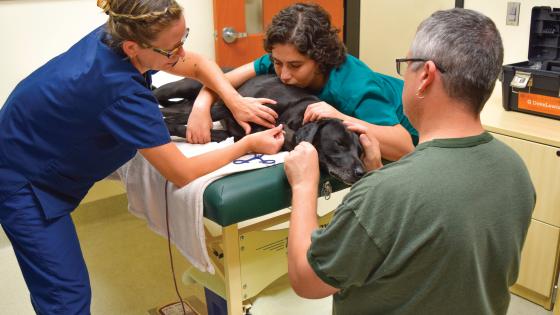
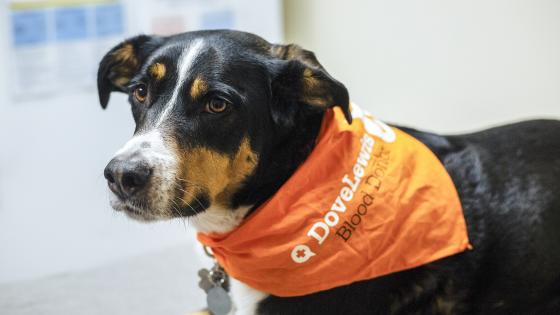
DoveLewis’ Superheroes donate enough blood for over 700 lifesaving transfusions every year. Portland’s pets are our canine donors, though we recruit feline donors exclusively from the veterinary community. Learn more about what it takes to be a Superhero in the DoveLewis Blood Bank.
Canine Donor Screening
All donors are DEA blood typed and antibody screened and tested against the following: Dirofilaria sp., Bartonella sp., Anaplasma sp., Babesia sp., Ehrlichia sp., Borrelia burgdorferi, Hepatozoan sp., Leishmania sp., Mycoplasma sp., Neorickettsia risticii and Rickettsia ricketsii.
Some dogs have been found to have naturally occurring antibodies; however, incompatibility reactions are much less severe compared to cats. We cannot guarantee that administering Universal or 1.1 Negative blood to an untyped canine will not result in a transfusion reaction. We encourage the typing of dogs prior to transfusion. Additionally, cross matching is necessary in all patients if it has been more than three days since a previous transfusion as antibodies can develop during this time frame.
Feline Donor Screening
All donors are screened for the following: FeLV, FIV, feline coronavirus (FIP PCR), Mycoplasma sp., Ehrlichia sp., Anaplasma sp., Cytauxzoon felis, Bartonella sp. and Dirofilaria sp.
Cats have naturally occurring antibodies against different blood types and transfusion of incompatible blood can result in a severe reaction. All feline recipients must be blood typed before the administration of any blood product due to the presence of naturally occurring alloantibodies.
What Products and Services Do we Offer?
Availability may fluctuate throughout the month. Order your blood products online for urgent and non-urgent needs.
Canine Blood Products
Whole Blood (available by request only)
Matched units of PRBCs & FFP are available
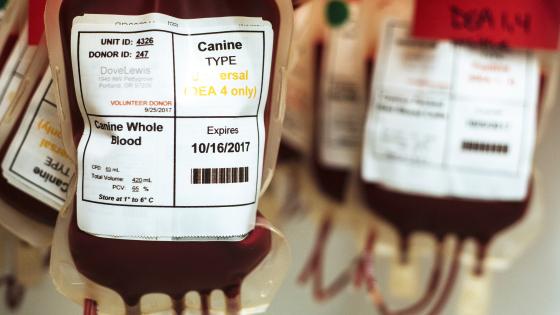
This is an anticoagulated whole blood unit collected that has been centrifuged and prepared for storage. It is the matching unit of packed red blood cells and its respective unit of fresh frozen plasma. The only component of whole blood missing from these units is viable platelets. Once the plasma is thawed, these units can be given in conjunction with each other to serve the needs of whole blood volume deficit. It is not intended for treatment of thrombocytopenia.
Packed Red Blood Cells
Volume: 200 - 300 mls
Pediatric units available upon request for smaller patients: 50 - 100 mls
Aseptic techniques are used to collect whole blood from canine donors. The red blood cells are separated from the plasma through centrifugation and a nutrient solution (Optisol) is added to preserve the red cells for up to 6 weeks in a refrigerator. Packed Red Blood Cells are used to treat symptomatic deficit of oxygen carrying capacity due to red cell loss. They are not intended to be used for hypovolemia without significant red cell loss or coagulopathies.
Fresh Frozen Plasma
Volume: 150 - 300 mls
Pediatric units available upon request for smaller patients: 50 - 100 mls
Note: Plasma in canines is not DEA type-specific, however, each of our donors are routinely screened for acquired serum antibodies against known DEA types.
This is the anticoagulated (CPDA) clear portion of centrifuged whole blood that is completely frozen within 8 hours of collection. It contains all components of the coagulation cascade, oncotic proteins, immunoglobulins, lipids and electrolytes. Fresh frozen plasma is indicated for the treatment of mild and severe coagulopathies and hypoproteinemia and is viable in a freezer for up to 1 year after collection. It can also be used for Von Willebrands’ patients. It is not intended to treat hypovolemia if coagulation factors are normal.
Frozen Plasma
Volume: 150 - 300 mls
Pediatric units available upon request for smaller patients: 50 - 100 mls
This is the anticoagulated (CPDA) clear portion of centrifuged whole blood that is completely frozen within 5 days of collection or after 1 year when the labile coagulation factors expire in fresh frozen plasma. It is good for up to 5 years frozen. It is indicated for volume expansion with hypoproteinemia, Vitamin K dependent coagulopathy and immunoglobulin transfer. It is not intended to use for replacement of labile clotting factors (V, VIII, vWF, XII).
Cryoprecipitate
Volume: 75 - 150mls
This is a controlled and slow thaw of fresh frozen plasma that results in a concentration of labile coagulation factors – specifically vWF and factors VIII and XIII. It is intended as a pretreatment for vWF or Hemophilia A patients before invasive procedures. It can also be used as therapy for patients suffering an acute bleed for replacement of these labile coagulation factors. It is not intended for treatment of coagulopathies of nonlabile clotting factors or as a source of proteins or immunoglobulins.
Cryo-Poor Plasma
Volume: 150 - 200 mls
Feline Blood Products
Packed Red Blood Cells
Volume: ~30 mls
Aseptic techniques are used to collect whole blood from feline donors. The red blood cells are separated from the plasma through centrifugation and a nutrient solution (AS-3) is added to preserve the red cells for up to 5 weeks in a refrigerator. Packed Red Blood Cells are used to treat symptomatic deficit of oxygen carrying capacity due to red cell loss. They are not intended to be used for hypovolemia without significant red cell loss or coagulopathies.
Fresh Frozen Plasma
Volume: ~30 mls
Plasma in felines is type specific. All recipients should be blood typed before the administration in any plasma product. This is the anticoagulated (CPDA) clear portion of centrifuged whole blood that is completely frozen within 8 hours of collection. It contains all components of the coagulation cascade, oncotic proteins, immunoglobulins, lipids and electrolytes. Fresh frozen plasma is indicated for the treatment of mild and severe coagulopathies and hypoproteinemia and is viable in a freezer for up to 1 year after collection.
Frozen Plasma
Volume: ~30 mls
This is the anticoagulated (CPDA) clear portion of centrifuged whole blood that is completely frozen within 5 days of collection or after 1 year when the labile coagulation factors expire in fresh frozen plasma. It is good for up to 5 years frozen. It is indicated for volume expansion with hypoproteinemia, Vitamin K dependent coagulopathy and immunoglobulin transfer.
Whole Blood (available by request only)
Matched units of PRBCs & FFP are available
This is an anticoagulated whole blood unit collected that has been centrifuged and prepared for storage. It is the matching unit of packed red blood cells and its respective unit of fresh frozen plasma. The only component of whole blood missing from these units is viable platelets. Once the plasma is thawed, these units can be given in conjunction with each other to serve the needs of whole blood volume deficit. It is not intended for treatment of thrombocytopenia
Blood Orders + Pricing
Our online order form is the fastest way to request blood products.
Your Team's Cats Can Donate!
We recruit our feline superheroes from the households of veterinary professionals only, and we'll come to you! Schedule your team's donation day with us.
Blood Bank Contact
Use our online form to order products quickly and efficiently.- Kelsey Reinauer
- Email Department
- (971) 255-5920
Helpful Resources